Historical Movies: Best Must-Watch Ancient History Epics
Historical Movies: Best Must-Watch Ancient History Epics
Historical movies have a unique power to transport audiences across centuries, placing them in the middle of lost civilizations, legendary battles, royal courts, and world-changing conflicts. When these films focus on ancient history, they often combine grand storytelling with striking visuals, unforgettable characters, and a sense of scale that few other genres can match. Whether they are strictly accurate or take creative liberties for dramatic effect, the best ancient epics make the past feel immediate, human, and thrilling.
From the rise and fall of empires to stories of warriors, rulers, philosophers, and revolutionaries, ancient history films offer much more than spectacle. They explore ambition, faith, betrayal, honor, and survival in settings that still shape modern imagination. If you are looking for unforgettable films set in the ancient world, this guide highlights some of the most compelling options to add to your watchlist.
Why Ancient Epics Remain So Popular
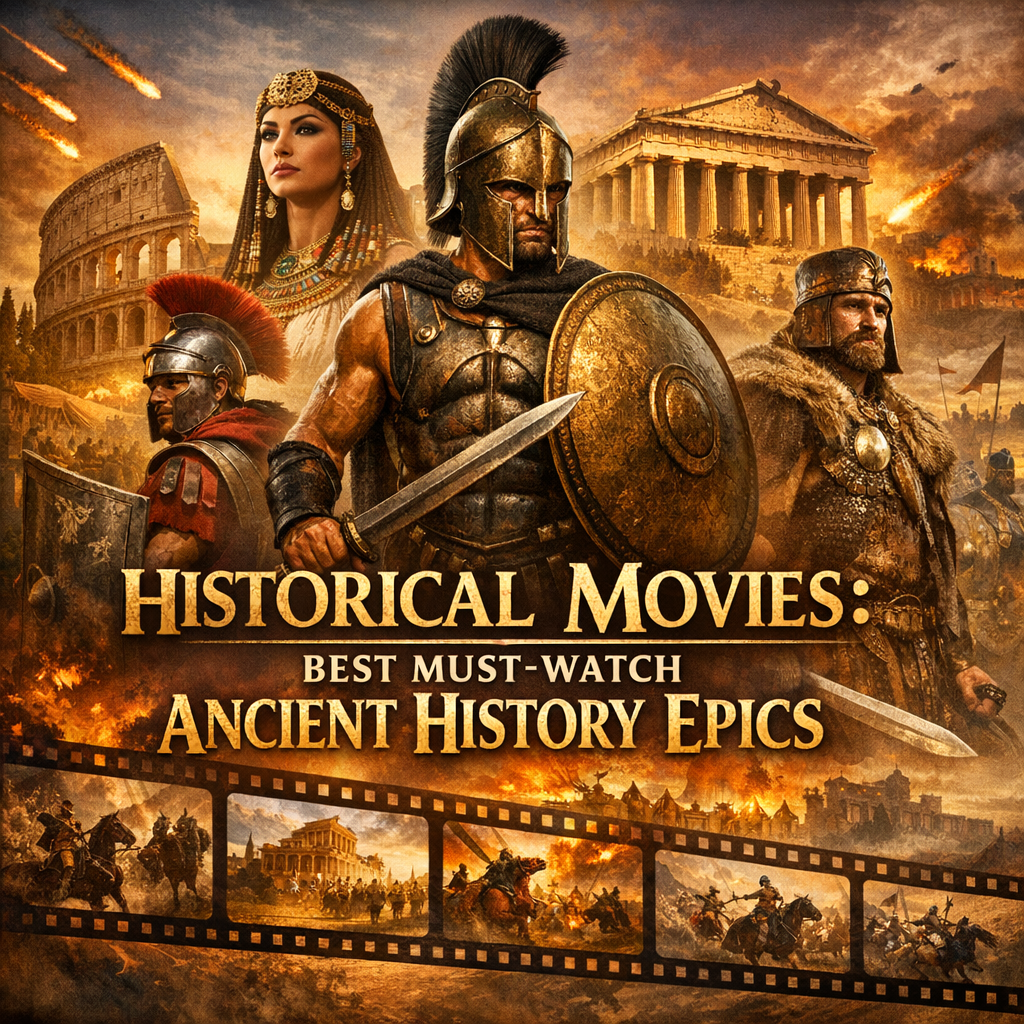
There is something timeless about stories set in the ancient world. Massive armies, marble cities, desert kingdoms, and mythic reputations give these films an atmosphere that feels larger than life. At the same time, the emotions at the center of these stories are deeply familiar. Love, revenge, political struggle, and personal sacrifice connect modern viewers to people who lived thousands of years ago.
Ancient epics also benefit from a strong cinematic tradition. Directors often use sweeping landscapes, rich costume design, dramatic music, and large ensemble casts to create a sense of immersion. The result is a type of movie that feels both educational and entertaining. Even when historians debate a film’s accuracy, audiences are often drawn in by the vivid attempt to recreate another era.
Must-Watch Historical Movies Set in the Ancient World
Gladiator (2000)
Few ancient epics have had the cultural impact of Gladiator. Set in the Roman Empire, the film follows Maximus, a respected general betrayed by the emperor’s son and forced into slavery. As he rises through the brutal world of gladiatorial combat, his personal quest for justice becomes tied to the fate of Rome itself.
What makes Gladiator so memorable is its balance of emotional depth and spectacle. The arena sequences are intense, but the film also succeeds because of its central performance and themes of loyalty, corruption, and lost honor. It is often the first recommendation for anyone interested in Roman-era cinema, and for good reason.
Ben-Hur (1959)
A classic of epic filmmaking, Ben-Hur remains one of the most celebrated examples of historical storytelling on screen. Set in Judea under Roman rule, it tells the story of Judah Ben-Hur, a prince betrayed by a former friend and sent into slavery. His journey eventually leads to revenge, redemption, and spiritual transformation.
The film is famous for its chariot race, which still stands as one of the most impressive action sequences in cinema history. Beyond that, it offers scale, drama, and a powerful emotional arc that makes it essential viewing for fans of ancient settings.
Spartacus (1960)
Another powerful Roman epic, Spartacus dramatizes the story of the slave who led a major uprising against the Roman Republic. The film presents both the cruelty of slavery and the inspiring determination of people who refused to accept oppression.
With strong performances and a compelling political dimension, Spartacus goes beyond action. It raises questions about freedom, power, and the price of resistance. It is a film with both historical significance and enduring cinematic appeal.
Troy (2004)
Inspired by Homer’s Iliad, Troy brings one of the most famous conflicts in ancient mythology and literature to the screen. The story centers on the war between the Greeks and Trojans, featuring iconic figures such as Achilles, Hector, Agamemnon, and Paris.
Although it blends myth and historical imagination, Troy is a gripping large-scale epic filled with duels, strategy, and tragic heroism. The film works especially well for viewers who enjoy character-driven stories set against the backdrop of legendary warfare. Hector and Achilles, in particular, give the film much of its emotional and dramatic strength.
Alexander (2004)
Oliver Stone’s Alexander takes on the life of Alexander the Great, one of history’s most ambitious and influential conquerors. The film follows his rise from youth to military legend, tracing his campaigns across Persia, Egypt, and beyond.
This is a more reflective and complex epic than some viewers expect. Instead of focusing only on action, it examines Alexander’s psychology, leadership, personal relationships, and vision of empire. While opinions on the film vary, it remains a notable attempt to portray one of the ancient world’s most fascinating figures.
Agora (2009)
For those who want something thoughtful and less battle-centered, Agora is an excellent choice. Set in Roman Egypt, the film focuses on Hypatia, a philosopher and mathematician in Alexandria during a time of religious and political upheaval.
Unlike many ancient films that center on warfare, Agora emphasizes ideas, knowledge, and the fragility of intellectual life during turbulent historical change. It offers a different perspective on ancient history, showing how conflict can destroy not only people and cities, but also learning and culture.
The Passion of the Christ (2004)
While controversial in some respects, The Passion of the Christ is undeniably one of the most intense and widely discussed films set in the ancient world. Focusing on the final hours of Jesus, it presents Roman-occupied Judea with stark realism and emotional intensity.
The film is not a broad historical epic in the traditional sense, but it has a strong sense of period and remains an important work for viewers interested in ancient religious history and its cinematic interpretations.
Cleopatra (1963)
Lavish, dramatic, and visually striking, Cleopatra tells the story of the Egyptian queen and her relationships with Julius Caesar and Mark Antony. The film explores political maneuvering, romance, imperial ambition, and the cultural tensions between Egypt and Rome.
Its production is famous for its scale, and that grandeur still makes an impression. More importantly, the film captures the complexity of Cleopatra as a ruler navigating immense pressure from powerful men and shifting empires.
What Makes the Best Historical Movies Stand Out
The strongest films in this genre do more than recreate old clothing and battle formations. They make history feel alive through character, atmosphere, and conflict. Great ancient epics often share a few important qualities:
– A compelling central figure viewers can follow through political and personal turmoil
– Strong world-building that makes the setting feel immersive
– Moral complexity rather than simple heroes and villains
– Visual ambition that matches the scale of the story
– Emotional stakes that keep the narrative grounded
Even when a movie is not perfectly accurate, it can still inspire curiosity about real events and historical figures. In many cases, these films serve as a starting point that encourages viewers to read more about Rome, Greece, Egypt, Persia, or early religious history.
How to Enjoy Historical Movies More Deeply
One of the best ways to appreciate ancient epics is to watch them with both imagination and curiosity. Enjoy the drama, but also take time afterward to explore what the film changed, simplified, or invented. Reading a short historical background or watching a documentary can add another layer of enjoyment.
It is also helpful to approach these movies as interpretations rather than textbooks. Filmmakers often compress timelines, combine characters, or dramatize events to make the story work on screen. That does not necessarily reduce their value. Instead, it reminds us that cinema and history have a fascinating relationship: one seeks to entertain, the other to explain, and the best films often do a bit of both.
Final Thoughts on Historical Movies
Ancient history epics continue to captivate because they bring distant worlds into vivid focus. They show the grandeur of empires, the brutality of war, the tension of politics, and the deeply human stories behind legendary names. Whether you prefer Roman arena drama, Greek war tales, Egyptian royal intrigue, or intellectually driven stories from the ancient Mediterranean, there is no shortage of remarkable films to explore.
For anyone building a watchlist, these historical movies offer a strong place to begin. They combine scale, emotion, and memorable storytelling in ways that make the ancient world feel thrillingly alive.
